
More


A correctly cleaned and protected heating system can deliver noticeable improvements in performance, particularly where contamination has previously affected efficiency. However, the inhibitor itself isn’t something a homeowner can see. There’s no new component to point at or visible sign of the protection it provides, even though it’s working continuously to help prevent corrosion and limescale.
That’s why inhibitor is one of the easiest steps to rush or overlook when time is tight.
The problem is that corrosion doesn’t wait. Boiler manufacturer research has suggested that poor water treatment contributes to up to 87% of boiler breakdowns, yet preventing it takes only a few minutes during commissioning. A heating system that isn’t correctly protected may continue to operate normally for months or even years before the consequences become obvious, but by then, the damage may already have begun.
With immediate effect, all new packaging and labelling will meet the enhanced substantiation requirements introduced by the ECGT Directive and its amendments to the UCPD.
This includes ensuring that generic environmental claims are always accompanied by a clear and substantiated specification, that sustainability-style iconography is only used when it reflects a recognised certification scheme or public-authority label, and that any social-characteristic claims remain accurate, relevant and capable of substantiation.
Corrosion and limescale don’t always develop at the same rate.
While many of their effects build up gradually over months or years, corrosion can begin much sooner than many people realise. For example, flash corrosion can occur soon after a system is filled or refilled if the water isn’t properly protected. Although a heating system may continue to appear to be working normally, corrosion products can already be accumulating in radiators, pipework and heat exchangers.
Limescale typically develops more gradually. However, studies have shown that as little as 1.6 mm of limescale can reduce heat transfer by around 12%, forcing the system to work harder to deliver the same level of comfort.
By the time homeowners notice cold spots, noisy boilers or reduced efficiency, the underlying water quality problem may already have been developing for some time. Correct inhibitor dosing helps prevent those issues from developing in the first place. It also supports compliance with BS 7593 and aligns with the water treatment requirements set out by many boiler and heat pump manufacturers as part of their commissioning and warranty guidance.
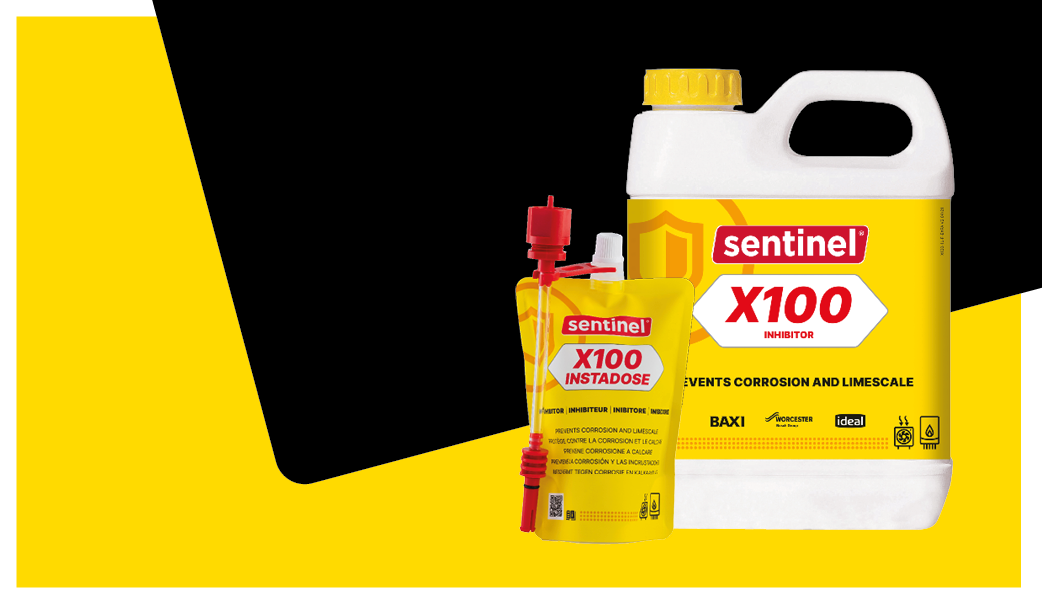
For nearly four decades, Sentinel X100 has been helping protect domestic heating systems against corrosion and limescale. It’s one of the most widely recognised inhibitors in the industry, identified by many engineers simply as “the yellow bottle.”
That recognition has also led to an increasingly crowded market, with many own-brand alternatives adopting similar packaging.
While products may look similar on the merchant shelf, inhibitor formulations are not identical. Differences in corrosion protection, pH stabilisation and limescale control can influence long-term system performance, making product choice about more than simply selecting the lowest-cost option.
For installers, choosing a trusted inhibitor isn’t just about today’s installation, it’s about reducing the likelihood of tomorrow’s callback.
Correct dosing is straightforward in principle, but traditional inhibitor bottles still require engineers to estimate the correct amount for the system and handle any remaining product.
The new Sentinel X100 InstaDose has been designed to remove that step.
Each 250 ml InstaDose pouch treats up to 100 litres of system water, typically equivalent to a domestic heating system with around eight to ten radiators. Larger systems can be treated using two pouches. Designed as a simple dosing solution, InstaDose provides accurate dosing without the need for a pressurised can, while retaining the convenience of a ready-to-use pouch. With no leftover product and minimal clean-up, engineers can protect the system quickly as part of the installation process.
Removing unnecessary steps makes correct dosing the easiest option rather than the one that’s most likely to be skipped.
Commissioning isn’t the end of the story.
Inhibitor concentration should be checked during routine servicing, following component replacement, after significant system top-ups and whenever a heating system has been drained and refilled. Routine servicing forms part of the ongoing maintenance approach set out in BS 7593, supporting compliance with Part L of the Building Regulations and helping maintain system efficiency.
A simple inhibitor test takes only a few minutes but provides valuable confirmation that the system remains adequately protected.
Using the Sentinel Instacheck kit allows engineers to verify inhibitor levels quickly and document that appropriate system protection has been maintained throughout the life of the installation.
Rather than treating inhibitor as a one-off commissioning task, inhibitor concentration should be checked as part of routine servicing in accordance with BS 7593, helping ensure the system remains properly protected throughout its service life.
X100 InstaDose forms part of The Sentinel System, which follows a simple best-practice approach:
Each stage supports the next.
A thoroughly cleaned system without inhibitor protection can begin corroding almost immediately after filling, even though the resulting sludge, reduced efficiency and component damage may not become noticeable until much later.
Following the complete Clean. Protect. Maintain. process helps maximise system efficiency, reduce future maintenance and support long-term heating system reliability.
How much X100 InstaDose does a typical heating system need?
One 250 ml InstaDose pouch treats up to 100 litres of system water (typically around eight to ten radiators). Larger systems may require two pouches.
How often should inhibitor levels be checked?
BS 7593 recommends checking inhibitor concentration as part of routine servicing. Levels should also be verified after major water loss, component replacement or whenever the system has been drained and refilled.
Is X100 suitable for hard water areas?
Yes. Sentinel X100 is formulated to protect heating systems in hard, soft and artificially softened water, helping defend against both corrosion and limescale.
Does InstaDose replace inhibitor testing?
No. Correct dosing and routine testing perform different functions. InstaDose ensures the correct amount of inhibitor is added during installation, while Instacheck confirms that effective inhibitor levels remain within the system over time.
Cleaning a heating system before commissioning is recognised as good practice throughout the industry. Protecting it afterwards deserves the same attention.
When accurate dosing takes less than a minute, there’s little reason for inhibitor to become the step that’s rushed or overlooked.
With Sentinel X100 InstaDose, protecting a heating system is as quick and straightforward as cleaning it, helping installers deliver reliable, compliant systems while reducing the likelihood of unnecessary call-backs in the years ahead.
Learn more about the Sentinel X100 InstaDose range or watch our latest video.

