
More


Winter call-backs don’t spread themselves evenly across the diary, they arrive when temperatures fall, customers need their heating most and engineers are already dealing with one of the busiest periods of the year.
Not every winter breakdown can be prevented, but frost protection is one area where decisions made before the temperature drops can make a significant difference.
The important thing is not to think of frost protection as a single product or setting. It starts with understanding where the system is vulnerable, how it is currently protected and whether that protection is still doing what it was intended to do.
Two heating systems in neighbouring properties won’t necessarily have the same frost risk.
Look at where the pipework runs and which parts of the system are exposed to lower temperatures. Potential areas to check include pipework running through garages, lofts
and other unheated spaces, exposed external pipework, external components associated with heat pump installations, external condensate pipework and properties
that are empty for long periods.
The first question shouldn’t therefore be: “Does this system need antifreeze?”
It should be: “Where could this system be vulnerable to freezing, and what’s protecting it?”
Heating appliances and systems can incorporate their own frost-protection measures, but those measures have operating requirements and limitations. For example, active
frost protection functions generally depend on the equipment having an electrical supply and being able to operate when required.
Insulation can protect vulnerable pipework, while other measures such as frost thermostats, antifreeze valves or inhibited antifreeze may form part of the overall approach depending on the installation.
There isn’t one answer that is right for every system. The appropriate approach depends on the equipment, where the risk sits, the property and the manufacturer’s
requirements.
Some of the most obvious frost risks are also among the simplest to address. Check that vulnerable pipework is properly insulated and that existing insulation hasn’t become damaged, displaced or removed.
For boiler installations, external condensate pipework should also be installed and protected in accordance with the boiler manufacturer’s instructions.
These checks don’t replace other forms of frost protection where they’re required, but they’re a sensible starting point.
Antifreeze valves are commonly used as part of the frost-protection strategy on some heat pump installations.
If a valve operates and releases system water to protect vulnerable external equipment, the job doesn’t necessarily end when temperatures rise again.
The system may subsequently require attention to restore the correct pressure, remove air and confirm that its water treatment remains at the required level.
That’s why the installer and customer both need to understand what the valve does and what action may be required if it operates.
Always follow the heat pump and valve manufacturers’ instructions for the particular installation.
Where inhibited antifreeze is appropriate, protection depends on using it at the correct concentration.
Simply knowing that a system contains antifreeze isn’t enough.
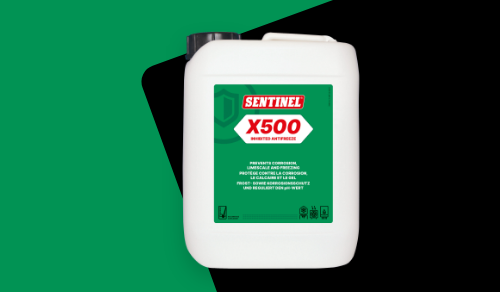
For Sentinel X500 Inhibited Antifreeze, Sentinel’s product instructions give different levels of frost protection according to concentration:
20% concentration – protection to -6°C
40% concentration – protection to -20°C
50% concentration – protection to -29°C
A minimum 20% concentration is required for corrosion and scale inhibition.
The aim isn’t therefore to add as much antifreeze as possible. It’s to establish the level of frost protection required and dose the product correctly in accordance with its instructions and the requirements of the heating equipment.
This is where frost protection becomes a maintenance issue rather than simply an installation consideration.
Heating systems change over time. Leaks can occur, radiators may be bled, components replaced and repairs carried out, while water lost from the system may be
replaced during routine top-ups. Each of these can alter the concentration of antifreeze within the system.
If plain water is added to a system containing antifreeze, the level of frost protection can gradually be reduced. A system that was correctly protected when it was commissioned therefore shouldn’t be assumed to provide the same level of protection several winters later.
This is why testing matters. Where antifreeze is present, its concentration should be checked using an appropriate test method and in accordance with the product manufacturer’s instructions. It should also be checked following significant water loss, repairs or topping up, with the result recorded for future servicing.
Protecting a system against freezing is only one part of looking after system water.
The system still needs to be appropriately cleaned and protected against corrosion and scale.
Where glycol or another thermal fluid is used, compatibility with other treatment products and system components needs to be confirmed.
Sentinel X500 Inhibited Antifreeze combines frost protection with corrosion and limescale protection for central heating systems.
But whichever products are being used, the first step should always be to understand what’s already in the system.
Before adding another treatment product, establish what is already in the system, check compatibility and follow the relevant manufacturers’ instructions.
For heat pump installations, also check the equipment manufacturer’s requirements for the system and any thermal fluid or frost-protection measures being used.
A service visit before temperatures fall is a good opportunity to look beyond whether the appliance fires.
1. Walk the system
Look for exposed pipework, unheated areas and other parts of the installation that could be vulnerable to freezing.
2. Check insulation
Look for missing, damaged or inadequate insulation around vulnerable pipework.
3. Establish the existing protection
Check whether the system relies on an appliance frost setting, insulation, frost thermostat, antifreeze valve, inhibited antifreeze or a combination of measures.
4. Find out what’s in the system
If antifreeze or another thermal fluid is present, identify the product where possible
rather than simply adding more.
5. Test the concentration
Where antifreeze is installed, check that its concentration still provides the intended
level of protection.
6. Ask about water loss and top-ups
If the system has lost water, been repaired or regularly topped up, its antifreeze concentration and inhibitor protection may have changed.
7. Check the wider water treatment
Use the same visit to consider inhibitor protection and filtration rather than treating frost protection in isolation.
8. Record what you find
Record the product, concentration and date tested so there is useful information available at the next service or repair.
Good frost protection isn’t only about what happens in the system. Customers also need to understand anything they are expected to do.
If the heating needs to remain operational during cold weather, tell them. If they’re going away, explain the manufacturer’s recommended settings rather than allowing them to assume switching everything off is the best option.
If a heat pump installation includes antifreeze valves, explain what they do and what the customer should do if one operates.
A short conversation before winter could help prevent a call-back when temperatures fall.
Does every central heating system need antifreeze?
No. The appropriate frost-protection strategy depends on the system, its location, the equipment manufacturer’s requirements and how the property is used. Antifreeze is one option, not an automatic requirement for every installation.
How much antifreeze does a heating system need?
That depends on the product and the temperature against which protection is required.
For Sentinel X500, the product instructions specify different concentrations for different levels of frost protection. Always dose according to the product instructions.
How do you know if the antifreeze concentration is still correct?
Test it using an appropriate method for the product. Water loss, repairs, bleeding and topping up can change the concentration over time.
Should antifreeze concentration be checked after topping up?
Yes. Adding water can dilute the antifreeze already present, so the concentration should be checked rather than assumed.
Does antifreeze replace inhibitor?
Not automatically. Frost protection and corrosion protection are separate considerations, although inhibited antifreeze products such as Sentinel X500 are formulated to provide both. Always check the product specification and compatibility with the system.
Is frost protection different on a heat pump?
Heat pump installations can introduce different considerations, particularly where components or pipework are outside the building. Follow the heat pump manufacturer’s requirements and use frost-protection measures suitable for the particular installation.
Frost protection is much easier to assess before winter than it is when a customer has no heating on one of the coldest days of the year.
Before winter arrives, check where the frost risk sits, understand what is already protecting the system and test antifreeze rather than assuming it remains at the correct concentration. It’s also a useful opportunity to check the wider water treatment and make sure the system is properly protected for the months ahead.
It’s another example of why Clean. Protect. Maintain. isn’t simply about what goes into the system at installation. It’s about keeping that protection working throughout the life of the system.
Explore Sentinel X500 Inhibited Antifreeze, or read Sentinel’s winter heating protection guidance for more practical advice on preparing heating systems for colder weather.

