
More


Ask several boiler manufacturers whether inhibitor is required and the answers won’t necessarily sound the same. Some refer to inhibitor directly in their warranty terms, while others focus more broadly on water quality, correct system preparation or faults caused by contamination. The wording varies, but the principle behind it is remarkably consistent: the condition of the water circulating through a heating system matters to the performance and reliability of the boiler connected to it.
For heating engineers, that makes inhibitor much more than an additional chemical to add at the end of a job. Correct water treatment forms part of protecting the complete heating system, and manufacturer guidance, BS 7593 and the industry’s Benchmark process all reinforce the importance of getting that treatment right.
Some boiler manufacturers are very clear about inhibitor in their published guidance and warranty documentation. For example, manufacturer terms reviewed for this article state that the system should be flushed and cleansed in accordance with BS 7593 before corrosion inhibitor is introduced into the clean primary water system. The same manufacturer’s customer guidance recommends checking inhibitor concentration every 12 months, or sooner if system water has been lost.
There are two useful points for engineers here. The first is that water treatment isn’t simply an optional recommendation sitting separately from the rest of the installation; it can form part of the manufacturer’s expectations around how the system is prepared and maintained.
The second is that the guidance refers engineers back to the water-treatment manufacturer’s instructions, meaning the correct product dosage and application need to be determined by the treatment being used and the system it is being added to.
In practical terms, adding inhibitor isn’t simply a box to tick during commissioning. It needs to be correctly dosed in the first place and its effectiveness checked as the system is maintained over time.
Some manufacturer guidance approaches the subject through regulation and industry standards. Guidance published in response to changes to Part L, for example, points installers towards BS 7593 for system preparation and commissioning and recommends adding a suitable chemical inhibitor to the primary heating circuit to protect against scale and corrosion.
This connection is important because it places inhibitor within a much wider approach to system health. The objective isn’t simply to satisfy a manufacturer requirement or protect a warranty; it is to leave the complete heating system properly prepared and protected against the problems that can develop once it is in operation.
Low-temperature systems require additional consideration too. Manufacturer guidance referencing BS 7593 highlights the need to consider microbiological protection where systems operate at lower mean water temperatures, which is particularly relevant as more engineers work with heat pumps and other low-temperature heating systems.
Whatever system is being installed or serviced, the important point is to follow the requirements and guidance relevant to that particular appliance and system rather than assuming the same treatment approach applies everywhere.
Individual boiler manufacturers may use different language, but underneath their guidance sits a common industry framework. BS 7593 provides the recognised code of practice for preparing, commissioning and maintaining domestic central heating and cooling water systems, while the HHIC Benchmark process brings system preparation and water treatment into the commissioning and servicing record.
Benchmark includes confirmation that the system has been flushed and cleaned and that a suitable inhibitor has been applied on final fill, in accordance with BS 7593 and the boiler manufacturer’s instructions. It also addresses inhibitor testing during annual servicing.
That ongoing testing is particularly important because system protection can change over time. Water can be lost, radiators can be removed or replaced, repairs can be carried out and systems can be topped up. Any of these can affect the concentration of inhibitor remaining in the system, which is why assuming that a system is still protected simply because inhibitor was added several years ago isn’t enough.
Testing gives the engineer a clearer picture of the condition of the system and provides a basis for deciding whether treatment needs attention.
Not every boiler manufacturer explicitly refers to inhibitor in its warranty terms. Some focus instead on the condition of the system water and exclude problems caused by contamination such as blockages, flux residues, iron oxides, limescale or sludge from free-of-charge cover.
That isn’t exactly the same as stating that a particular inhibitor must be used, but the practical implication is still important. If poor system water quality contributes to a fault, the resulting problem may not be treated in the same way as a fault originating with the appliance itself.
For an engineer, the sensible approach is therefore not to work backwards from the minimum wording in a warranty or guarantee. It is to prepare and protect the heating system properly, following the relevant manufacturer instructions and recognised water-treatment guidance from the outset.
The difference between cleaning and protecting a heating system is particularly important here because the benefits of a cleaner are often much easier to see. Dirty system water can clear, corrosion debris can be removed and circulation can improve, giving both the engineer and customer an immediate indication that something has changed.
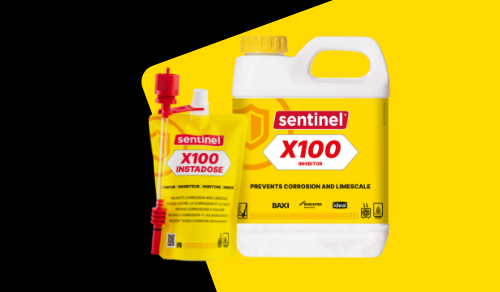
Inhibitor does a different job. Once a system has been appropriately cleaned, Sentinel X100 Inhibitor provides leave-in protection against corrosion and limescale, helping to protect the system after the cleaning work has been completed. Its preventative role is naturally less visible, but that doesn’t make it less important.
Put simply, cleaning deals with contamination that is already present, while inhibitor helps protect against problems developing afterwards. Both stages form part of Sentinel’s Clean. Protect. Maintain. approach to water treatment.
If inhibitor is going to provide the intended protection, it needs to be dosed correctly for the system being treated. Engineers should therefore follow the water-treatment manufacturer’s instructions, taking account of system volume and the particular product being used rather than relying on an estimated or habitual dose.
Products such as Sentinel X100 InstaDose are designed to make this part of the job simpler, providing a convenient dosing format that can help engineers incorporate inhibitor into commissioning and servicing without adding unnecessary complexity on site. Whatever format is chosen, the principle remains the same: use the correct treatment, apply the correct dose and maintain that protection over the life of the system.
This is also where testing becomes valuable. Checking inhibitor concentration during subsequent services helps establish whether effective protection remains in place and whether any further action is required, rather than relying on assumptions about what was added previously.
Read Sentinel’s guide to dosing a central heating system.
No. Manufacturer wording varies. Some refer specifically to inhibitor in their guidance or warranty documentation, while others focus on correct water treatment, compliance with BS 7593 or exclusions relating to contaminated system water. Engineers should always check the current instructions and terms for the appliance they are working on.
It can. Warranty and guarantee conditions vary between manufacturers, but water quality and correct system preparation can be relevant to whether particular faults are covered. Problems attributable to contaminated system water may be treated differently from faults with the boiler itself, so engineers should follow the applicable manufacturer’s current requirements.
Inhibitor protection should be checked as part of ongoing system maintenance and in line with the relevant manufacturer and water-treatment guidance. Testing is particularly important after water loss, repairs or alterations to the system, as these can affect inhibitor concentration.
Yes. BS 7593 includes consideration of microbiological protection in low-temperature systems, making water treatment particularly important for systems such as heat pumps where operating conditions can differ from conventional boiler systems.
A boiler may be the most obvious component in a heating system, but its performance and reliability can’t be considered in isolation from the water circulating through it. That is why manufacturer guidance repeatedly comes back to system preparation, water quality and ongoing maintenance, even when the exact language around inhibitor differs.
For heating engineers, the practical approach is straightforward: clean the system appropriately, protect it with correctly dosed inhibitor and maintain that protection through routine checking and testing. Following that Clean. Protect. Maintain. approach helps protect the complete heating system and provides a clear, documented approach to good water-treatment practice.
Explore the Sentinel X100 Inhibitor range and X100 InstaDose for ongoing protection against corrosion and limescale, or read Sentinel’s Complete Guide to Central Heating Protection Before Winter for more practical guidance on preparing systems for the heating season.

